





RESUMO
-
- A abertura da tela de peneiramento é a abertura que permite que o material de alimentação abaixo do tamanho mínimo passe pela superfície de peneiramento.
- A forma da abertura afeta o dimensionamento, a drenagem, a resistência ao entupimento, o comportamento ao desgaste e a capacidade de processamento.
- A mesma abertura nominal pode apresentar um desempenho de peneiramento diferente quando a geometria do painel, o formato das partículas, a umidade e as condições da plataforma mudam.
- A melhor abertura de substituição deve ser selecionada de acordo com o problema de peneiramento, e não copiada apenas do painel desgastado.
O que é uma abertura na tela de projeção?
Mídia de tela é o painel, a tela metálica ou outra superfície de peneiramento instalada na plataforma. O material de alimentação é a rocha, o minério, o carvão, a pasta ou outro material que está sendo peneirado.
A abertura de uma tela de peneiramento é uma abertura na superfície de peneiramento que permite a passagem do material subdimensionado, retendo o material sobredimensionado. As dimensões dessa abertura são comumente chamadas de tamanho da abertura ou tamanho nominal da abertura.
Por que a forma da abertura é importante
A forma da abertura altera o percurso que o material a ser processado segue na superfície da mesa. Ela pode favorecer a classificação precisa por tamanho, maior resistência à abrasão, melhor drenagem, resistência ao entupimento por partículas de tamanho próximo ou o controle da passagem de partículas alongadas. Além disso, altera a estrutura ao redor de cada abertura, incluindo pontes, margens, ângulos de desbaste e espessura do painel.
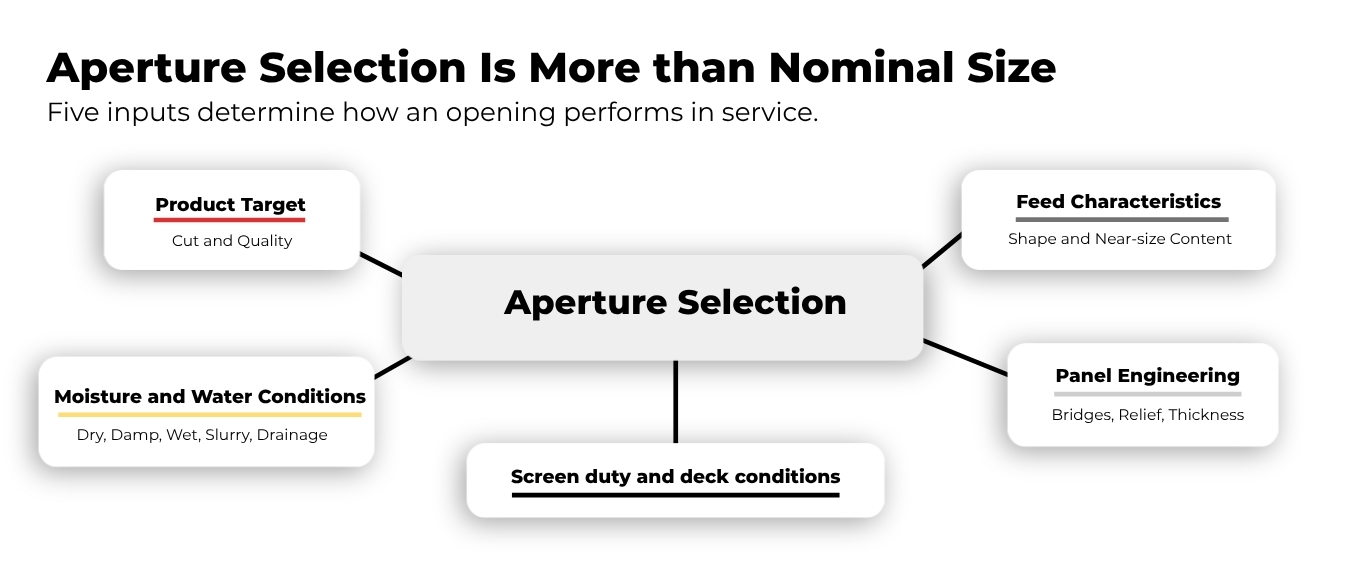
Cinco fatores decisivos que determinam o desempenho da abertura.
Cinco fatores que influenciam o desempenho da abertura:
- Dimensões e especificações exigidas do produto
- Forma das partículas e fração por tamanho aproximado
- Condições de umidade e água: seco, úmido, molhado ou com lama; carga de água; e direção da drenagem
- Projeto de painéis: pontes, margens, ângulos de desbaste, espessura dos painéis e geometria das aberturas
- Condições de operação da peneira e do leito: impacto, abrasão, distribuição da alimentação, profundidade do leito, movimento da peneira e fluxo de material
Qual é o melhor formato de abertura para mídias de tela?
Não existe uma forma de abertura que seja universalmente a melhor. A verdadeira questão é: qual comportamento da abertura atende melhor a essa aplicação?
| Comparação entre os formatos de abertura das telas | ||
|---|---|---|
| Projeto de abertura | Comportamento útil | Corte padrão |
|
Quadrado
|
Ele se destaca na classificação precisa por tamanho e ajuda a impedir a passagem de materiais achatados e alongados. | Dimensionamento geral, em que a especificação do produto é a prioridade |
|
Redondo
|
Oferece pontes e margens mais amplas para maior durabilidade e vida útil. | Aplicação em escarificação primária e em serviços pesados |
|
Com ranhuras
|
A orientação pode facilitar a drenagem, reduzir o entupimento ou influenciar a passagem de partículas de tamanho excessivo. | Aplicações em ambientes úmidos, com foco em drenagem ou que exigem precisão dimensional |
|
Modelos especiais, incluindo o Polydeck HVR
|
A geometria projetada e o movimento em ponte podem ajudar a liberar material de tamanho próximo ao desejado; o Polydeck HVR também é capaz de processar fluxos úmidos e de alto volume. | Entupimentos persistentes, alto fluxo de água ou condições de trabalho que exigem tubos de grande diâmetro |




Como se comportam as aberturas quadradas, redondas, com fenda e especializadas
Aberturas quadradas
As aberturas quadradas costumam ser um excelente ponto de partida quando a classificação precisa por tamanho das partículas é a prioridade. Sua geometria ajuda a limitar a passagem de materiais planos e alongados que poderiam passar por uma abertura mais longa.
Aberturas redondas
As aberturas redondas permitem pontes e margens mais largas ao redor das aberturas. Essa geometria pode contribuir para a durabilidade e a resistência ao desgaste na triagem primária e em outras aplicações de alta exigência. A área aberta dependerá do projeto completo do painel, e não apenas do formato da abertura.
Aberturas com fendas
Uma ranhura não apresenta um comportamento fixo. As ranhuras instaladas paralelamente ao fluxo de material podem melhorar a drenagem. Quando instaladas perpendicularmente ao fluxo, elas podem reduzir o entupimento e a passagem de material de tamanho excessivo.
Projetos de aberturas especiais, incluindo o Polydeck HVR
Os projetos de abertura especializados podem resolver desafios de peneiramento que as geometrias padrão — quadradas, redondas e com fendas — não resolvem com a mesma eficácia. A Polydeck desenvolve projetos exclusivos, como o HVR, com base em requisitos específicos de fluxo de material e autolimpeza.
O HVR combina uma geometria capaz de ajudar a aliviar a pressão hidráulica em aplicações em ambiente úmido e de alto volume com um movimento da ponte que permite autolimpante e liberação de material de tamanho próximo. Dependendo da função, isso pode ajudar a manter o fluxo de material, a drenagem e a área útil da abertura.
Por que o tamanho da abertura, por si só, não determina o desempenho da tela
O desempenho da peneira é complexo e depende de vários fatores além do tamanho da abertura. A forma e a orientação das partículas podem determinar se o material de tamanho próximo ao da abertura passa ou não. O ângulo da peneira, o movimento, a profundidade do leito e o tempo de permanência afetam a frequência com que o material atinge uma abertura. A construção do painel também pode alterar o comportamento de uma abertura à medida que o material de peneiramento se desgasta ou se flexiona durante o uso.
Como a orientação e o projeto do painel alteram o desempenho da abertura
A escolha da abertura não deve ser considerada isoladamente do painel ao seu redor. As pontes, as margens, os ângulos de alívio, a espessura do painel, a composição do material e o sistema de fixação determinam como um painel suporta a carga e como as aberturas se comportam durante o uso.
Como escolher a abertura correta para telas de substituição
- Defina as especificações do produto: corte exigido, tolerância para material deslocado e taxa de produção.
- Analise a matéria-prima: forma das partículas, fração por tamanho aproximado e condição do material.
- Leve em consideração as condições de umidade e água: ambiente seco, úmido, molhado ou com lama; carga hídrica; e direção da drenagem.
- Selecione a geometria, o tamanho e a orientação da abertura com base no problema de peneiramento, e não apenas no tamanho da abertura.
- Confirmar a engenharia do painel, a função da tela e o encaixe no tabuleiro: geometria da ponte e da margem, espessura, composição, fixação, impacto, abrasão, condição do suporte e zona do tabuleiro.
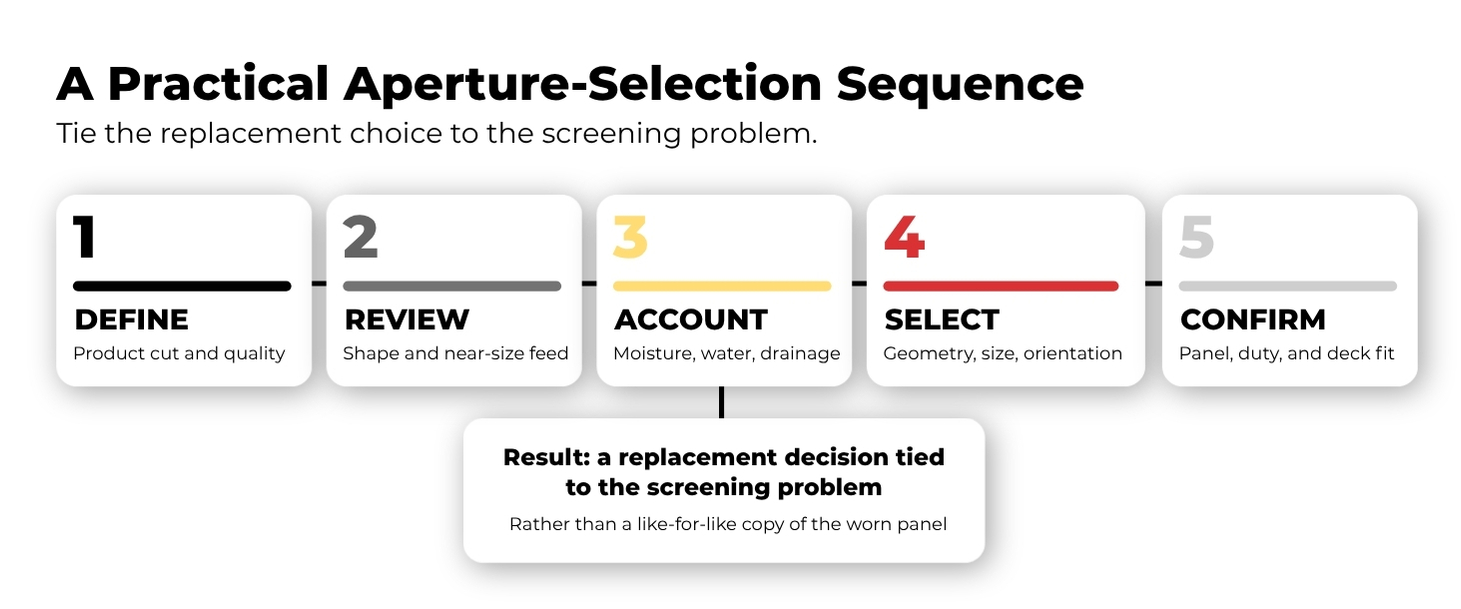
Uma sequência de cinco etapas para a seleção da abertura de substituição.
Sinais de que sua abertura atual pode não ser a mais adequada
- Entupimentos frequentes, obstruções ou redução da área útil aberta
- Drenagem lenta ou água estagnada no deck
- Perda de rendimento em condições operacionais que, de resto, se mantêm estáveis
- Alteração na consistência do produto, mesmo que a abertura nominal pareça correta
- Desgaste prematuro ao redor das pontes e das margens
- Substituição repetida por um produto com as mesmas especificações e o mesmo problema de funcionamento
Esses sintomas não significam necessariamente que a abertura esteja incorreta. São sinais de que é preciso verificar todo o sistema antes de solicitar novamente a mesma peça de reposição.
| Análise da escolha da abertura com base no problema atual | ||
|---|---|---|
| Se você vir isso | Comece verificando | Pergunta sobre abertura que se deve fazer |
| Obstrução persistente próxima ao diâmetro | Fração de granulometria próxima, umidade, adesão do material, movimento da tela e geometria atual | Será que um projeto com ponte flexível ou autolimpante melhoraria a liberação sem comprometer o controle do produto? |
| Drenagem lenta ou água estagnada | Orientação das ranhuras, volume de água, direção do fluxo, disposição dos painéis e drenagem a jusante | O projeto da abertura é adequado para a direção de drenagem e a carga hídrica exigidas? |
| Produto fora das especificações | Corte alvo, formato das partículas, geometria atual da abertura, movimento da plataforma e profundidade do leito | A forma atual permite orientações das partículas que não correspondem ao objetivo do produto? |
| Desgaste prematuro da ponte ou da margem | Impacto, abrasão, carga local, espessura do painel e condições de apoio | A abertura escolhida oferece suporte estrutural suficiente para a função? |
Resultados reais decorrentes de uma melhor escolha da abertura e do painel
Em Vale do Pinto, a Polydeck Screening Experts avaliou o layout da peneira por zona e combinou painéis resistentes na zona de alimentação com uma geometria de abertura flexível na parte posterior. O objetivo era controlar o impacto no local onde ele ocorria, ao mesmo tempo em que ajudava a manter o fluxo de material e a reduzir o entupimento ao longo da peneira. Essa estratégia de mídia ajudou a aumentar a produtividade em 25%.
Como a Polydeck aborda a seleção de aberturas
Os especialistas em peneiramento da Polydeck avaliam a abertura como parte do sistema completo de peneiramento. A avaliação leva em consideração o produto alvo, o material de alimentação, a forma das partículas, a umidade, o teor de partículas próximas ao tamanho alvo, o fluxo de água, o impacto, a abrasão, o layout das plataformas, as condições de suporte e o problema de desempenho que a fábrica está tentando resolver. Se você precisar de ajuda para resolver problemas relacionados à seleção da abertura, Entre em contato com a Polydeck hoje.
 Português do Brasil
  English
  Español de Chile