




SUMMARY
-
- Uneven material flow can overload part of the deck while leaving other screening areas underused.
- Localized wear patterns can help distinguish impact, sliding abrasion, uneven loading, problems with the deck support structure, and panels that are not seated or fastened correctly.
- Frequent product-quality corrections may point to issues with feed presentation, bed depth, screen operation, usable open area, or media selection.
- Screen media is an important part of the screening setup, but replacing panels before identifying the underlying condition can lead to a misaligned correction.
- A screen performance evaluation can help identify conditions that are not apparent through routine visual inspection.
Why These Signs Call for a Screening-Setup Review
A screening setup includes more than the screen media. Material enters at the feed end, spreads across the deck, stratifies, passes through apertures, and exits as oversize. Feed presentation, material flow, screen operation, panel support, and media design all influence that process.
When material flow, wear, or product quality changes, the source may be an alteration in feed conditions, operating conditions, mechanical condition, panel seating, or media strategy. A setup that performed well previously may need review as tonnage, material characteristics, production targets, or screen condition change.
These patterns can narrow the inspection, but they do not identify a single cause on their own.
Early Sign 1: Uneven Material Distribution Across the Deck
Material should use as much of the available deck width as the application allows. When feed consistently travels in a narrow lane or favors one side, that area carries more impact, abrasion, and bed depth than the rest of the screen. At the same time, underloaded areas are not contributing their full available open area to separation.
Common signs include:
- A visibly thicker material bed on one side of the deck
- Material entering in a narrow stream rather than spreading across the width
- One-sided buildup, carryover, or plugging
- Repeated wear in the same lane or row of panels
- Unused screening area beside an overloaded area
Possible contributors include feed-box wear, chute alignment, material trajectory, inconsistent feed rate, bed depth, and screen operation. The media strategy may also need review if the heaviest-duty panels are not located where material is actually landing.
Pay particular attention to feed-end screen panels, since their condition can help show whether impact and loading are concentrated at the first point of material contact.
What to inspect first:
- Observe material distribution across the full deck width while the screen is operating.
- Check feed-box wear, chute alignment, and the first point of material contact.
- Compare bed depth from side to side and from feed end to discharge end.
- Map the places wear, buildup, or panel movement is occurring.
- Review whether the heaviest-duty panels are located where material is actually landing.
Early Sign 2: Repeating Wear Patterns or Panel Movement
Repeating wear patterns and panel movement can provide useful diagnostic information. When the same panels, lanes, or rows wear, loosen, or fail early, the location and appearance of the damage can help identify the forces or conditions affecting that area. These patterns do not, however, automatically prove that the panel material or formulation is inadequate.
Cracking, tearing, chunking, broken corners, or loosened panels can indicate concentrated impact. Thinning, grooving, polishing, or gradual surface loss can indicate sliding abrasion and sustained material travel. One-sided or lane-specific wear often indicates that material is not spreading evenly across the deck width.
Damage around fasteners, repeated panel movement, or panels that loosen under load can point to a deck-support, fastening, panel-fit, or localized-impact problem.
| Repeating Wear Patterns in Screening | ||
|---|---|---|
| Wear Pattern | What It May Indicate | What to Check |
| Cracking, tearing, chunking, or broken corners | Concentrated impact | Drop height, feed angle, particle size, feed-box condition, and first point of contact |
| Thinning, grooving, or polishing | Sliding abrasion or sustained material travel | Material velocity, bed depth, tonnage, fines content, and panel formulation |
| One-sided or lane-specific wear | Uneven loading | Feed distribution, chute alignment, loading pattern, and deck coverage |
| Damage around fasteners or repeated panel movement | Problem with deck support, fastening, or panel seating | Rails, stringers, fastening integrity, panel fit, and localized impact |
The goal is to avoid applying a misaligned correction. A heavier panel may help with genuine impact damage, but it will not correct an off-center feed stream. Likewise, changing panel material may not resolve a problem with the deck support structure, fastening system, or panel seating.
Early Sign 3: Frequent Adjustments Are Needed to Maintain Target Performance
When operators repeatedly adjust the screen to maintain product quality, separation efficiency, or throughput, the issue may be more than normal operating variability. Frequent corrections can be associated with:
- Changing feed rate or inconsistent feed presentation
- Uneven bed depth
- Poor stratification
- Inadequate or unstable screen motion
- Reduced usable open area from wear, blinding, or pegging
- Aperture geometry or panel construction that no longer matches the application
- A media strategy that does not reflect the duty of each deck zone
Product quality, separation efficiency, and throughput are related but not interchangeable. Product quality relates to whether the output meets the intended specification. Screening efficiency relates to how effectively the screen makes the intended separation. And throughput relates to how much material the screen processes over time.
When any of these metrics begins to change, do not assume the nominal opening is incorrect. Remember how screening works: particles need to stratify, reach the screening surface, and encounter a usable opening before leaving the deck. Thus, changes in material flow, bed depth, screen motion, or usable open area can ultimately affect product quality, screening efficiency, throughput, or a combination of all three.
Why Recurring Screening Problems Rarely Stay Small
A narrow loading lane can increase localized wear, which can reduce usable open area or lead to unplanned panel replacements. Reduced open area and inconsistent bed depth, in turn, can affect separation efficiency and product consistency.
That chain reaction is why early signals are easier to correct than recurring failures. Waiting until panels fail repeatedly can lead to reactive maintenance, uneven changeout schedules, lost production time, and a less predictable screening process.
Investigate the Setup Before Changing Screen Media
Before ordering the same replacement panel or moving immediately to a heavier media option, review the screening setup in sequence.
- Watch material flow. Confirm whether material spreads across the deck width and travels consistently from feed to discharge.
- Check bed depth. Look for localized overloading, excessive depth at the feed end, or an uneven bed from side to side.
- Map the wear. Note which panels, lanes, and rows are wearing or failing first.
- Inspect the support system. Review rails, stringers, fastening points, panel seating, and areas where panels may move under load.
- Review screen operation. Verify that screen motion and operating conditions are appropriate for the application.
- Evaluate media by zone. Determine whether feed, active screening, and discharge zones need different priorities for impact resistance, open area, aperture behavior, or wear life.
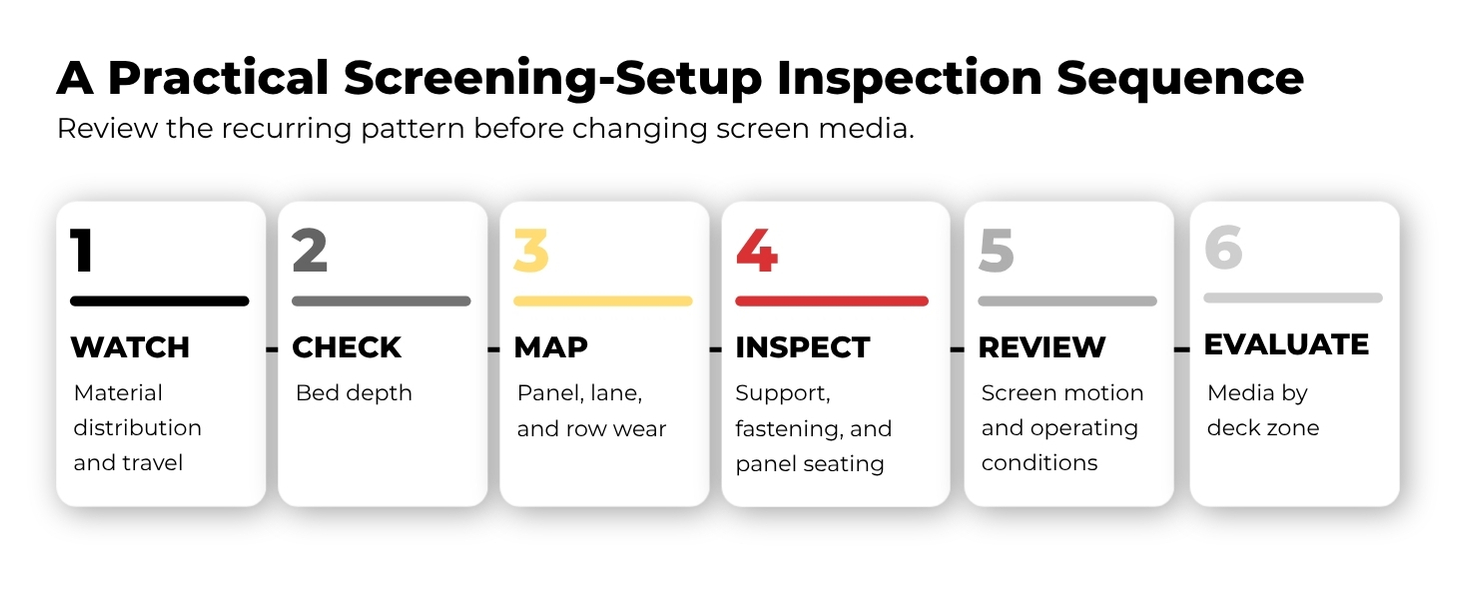
A practical sequence for reviewing a screening setup before changing screen media.
This sequence keeps the plant from treating every recurring issue as a screen-media problem. Screen media is critical, but it performs within a larger mechanical and material-flow setup.
When Media Strategy Is Part of the Solution
A change in screen media may be appropriate when the observed duty and the current panel design do not match.
- A feed zone with genuine impact damage that needs more durable media
- A downstream zone where added open area or different aperture behavior could improve separation
- A recurring plugging issue that calls for a different aperture geometry or flexing design
- A deck using the same media across zones with distinctly different duties
- A change in feed material, tonnage, moisture, particle shape, or product target
The key is to match the change to the observed failure mode and operating condition. A zone-specific media strategy can balance feed-end impact protection with screening efficiency and material flow farther down the deck.
How Polydeck Evaluates Recurring Screen-Performance Problems
When uneven flow, localized wear, or product-quality drift keeps returning, a PRO ANALYSIS: Screen Performance Evaluation can help determine whether screen operation is contributing to the problem and identify the conditions that need attention.
PRO ANALYSIS is an in-depth assessment of vibrating-screen health and performance. Polydeck Screening Experts inspect the screen’s specifications, design, and overall condition. They measure screen speed, stroke, g-force, side-plate movement, and support-structure movement with and without load, along with natural-frequency and operational measurements.
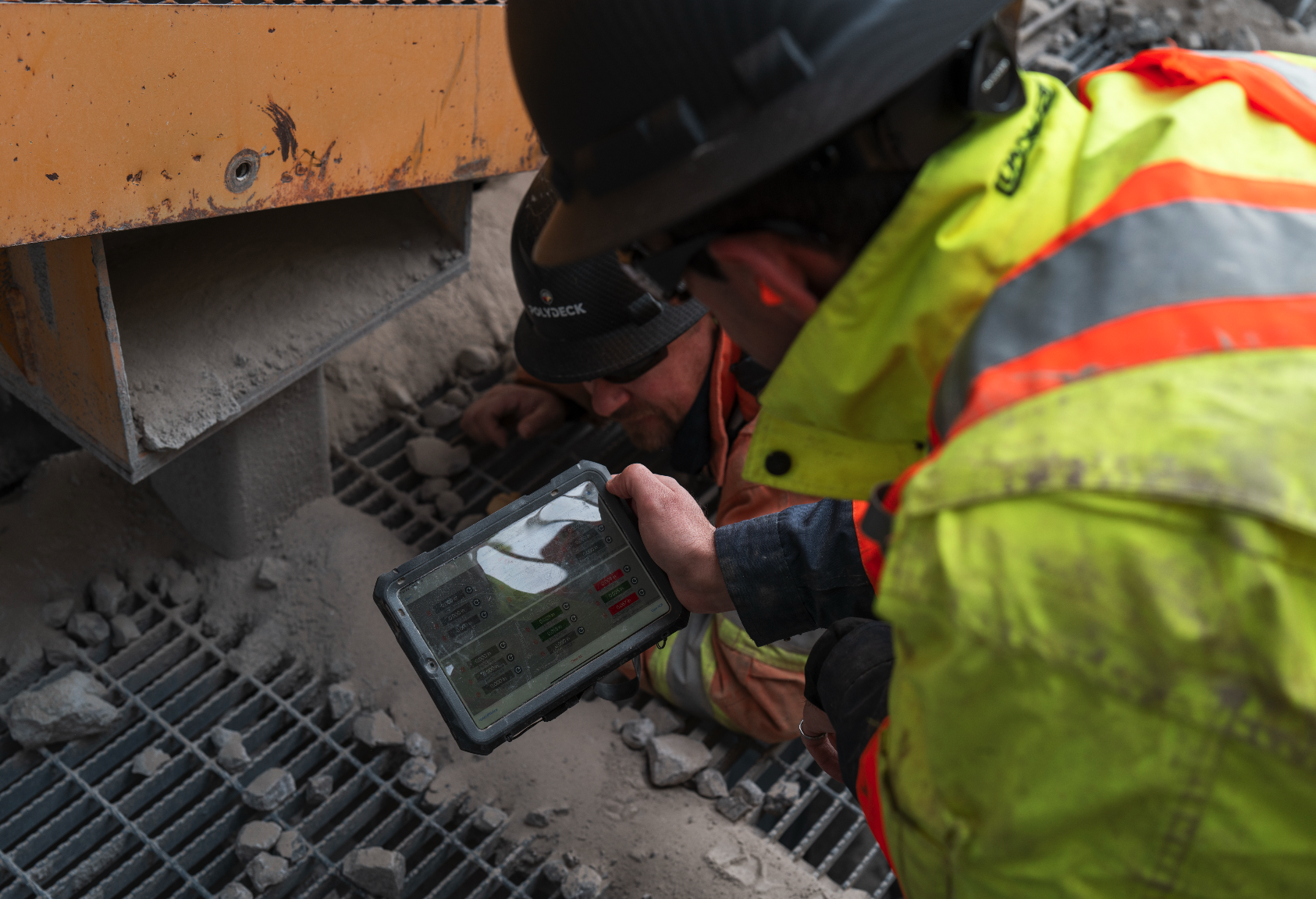
The evaluation also reviews feeding method and material distribution, high plugging or blinding zones, drive assembly and lubrication, and the suspension and support structure.
The result is analytical findings, a screen-condition report, and a screen-optimization plan that identifies areas for improvement and recommended next steps.
 English
  Español de Chile
  Português do Brasil