





SUMMARY
-
- Screening media is the working surface that separates material by size during screening.
- The main screen media materials are polyurethane, rubber, and wire.
- Polyurethane is often a strong choice in wet, wash-screen, and many general-purpose screening applications.
- Rubber is often best suited to dry, impact-heavy applications where durability is a priority.
- Wire media is often considered when open area, throughput, or traditional wire-style sizing performance are important.
- The best replacement screen media depends on more than material alone.
- Formulation, aperture design, panel engineering, mounting system, support structure, and deck geometry can all affect performance.
- Side-tension and modular systems can behave differently in service, and crowned versus flat screening surfaces can change how material flows across the deck.
What “Screening Media” Actually Means
Screening media is the screening surface installed on a deck to separate material by size. As the feed material moves across the deck, undersized particles pass through the apertures while oversized particles continue forward for further handling or processing.
Although the term can sound simple, screening media is not just a wear part. It directly affects how efficiently a screen performs, how consistently a plant hits spec, how quickly a deck wears, and how often maintenance crews need to intervene.
That is why screening media includes multiple materials, formulations, aperture designs, and mounting styles. The base material matters, but it’s only one part of how a screen surface performs in the field.
Why Screening Media Matters to Plant Performance
The screen surface influences how well material stratifies, how much usable open area is exposed, how easily water drains, how often plugging develops, and how quickly wear affects the deck.
If the wrong screen media is installed, the plant may see lower throughput, reduced efficiency, poor sizing accuracy, faster wear, or more downtime. Those issues often look like machine or maintenance problems at first, but in many cases the root issue is that the screen media strategy doesn’t match the application.
That is why replacement screen media should be treated as a performance decision, not just a routine purchase.
The Main Types of Screening Media Materials
The three main screening media materials are polyurethane, rubber, and wire.
Polyurethane media is one of the most versatile options in screening today. It can be engineered for wear resistance, flexibility, self-cleaning behavior, or resistance to hydrolysis and microbial degradation. Because of that range, polyurethane is commonly used in many general-purpose wet and dry screening environments.
Rubber media is generally selected for durability, resilience, and impact absorption. It’s often a strong fit where large material, gouging, and heavy loading create demanding dry screening conditions.
Wire media is often used where open area, throughput, and traditional wire-style screening performance are priorities. Depending on the application, it can be a strong fit in operations that value high capacity and responsive sizing performance, but its real-world results depend heavily on support conditions, wear progression, and maintenance practices.
When Polyurethane, Rubber, or Wire May Be the Right Fit
Polyurethane is often a strong starting point for wet and wash-screen applications, especially when wear life, drainage, and tailored aperture options are important. It can also perform well in a wide range of general screening applications.
Rubber is often best suited for dry, impact-heavy conditions where durability, gouge resistance, and long wear life are high priorities. It’s usually a better fit when impact and toughness matter more than maximizing drainage.
Wire media is often evaluated when high open area, throughput, and traditional wire-style performance are key priorities. In the right application, wire can be a practical choice where responsive screening and capacity are important. At the same time, the plant still needs to evaluate how the system is supported, how the surface wears, and how maintenance affects uptime over the life of the media.
| Screen Media Material Comparison | ||||
|---|---|---|---|---|
| Material | Best-Fit Conditions | Main Strengths | Tradeoffs | Common Replacement Goal |
| Polyurethane | Wet screening, wash screens, general-purpose duty | Tailored formulations, wear life, drainage options, self-cleaning options | May not be the best fit when extreme dry impact is the top concern | Improve wear life, drainage, or consistency |
| Rubber | Dry, impact-heavy, gouging-prone applications | Durability, resilience, impact absorption, long life in dry duty | Not usually the default answer for wet screening | Extend wear life in harsh dry service |
| Wire | High open area and wire-style throughput applications | Capacity, responsive sizing performance, familiar operating profile | Performance can drop with wear, tension loss, or full-sheet replacement demands | Maintain throughput or traditional wire-style screening behavior |
Material Is Only One Part of the Decision: Other Factors Affecting Screen Media Selection
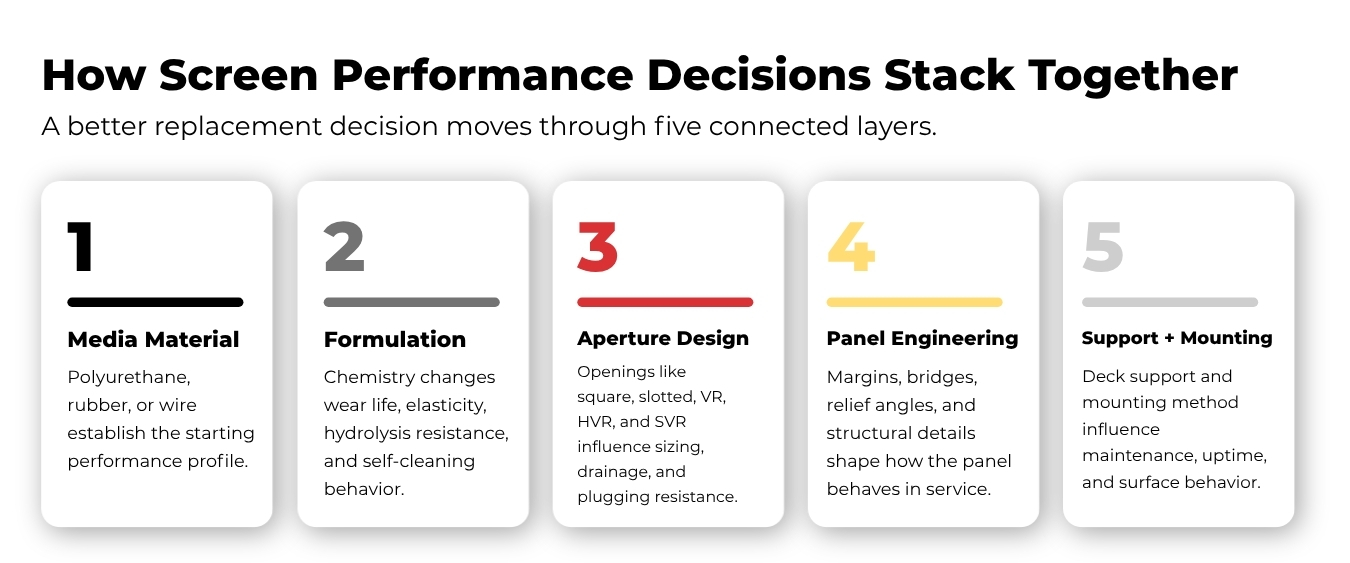
When people ask about choosing screening media, they often assume the answer is simply polyurethane versus rubber versus wire. In practice, that’s only the first layer of the decision.
Screen media selection usually involves:
- The media material itself
- The formulation of that material
- The aperture design
- How the panels are engineered (margins, bridges, opening angles, etc.)
- The deck support structure and mounting system
These factors matter because two screen surfaces made from the same material can behave very differently once they’re installed. Likewise, two systems using different materials can share some of the same performance behaviors if the support structure or screening geometry is similar.
Why Formulation Matters
Material formulation changes how the screen surface behaves under real operating conditions.
In Polydeck’s polyurethane line, XP is a balanced formulation for general screening. XP100 is designed for abrasive wet applications and high-tonnage wet duty. FXP increases elasticity and helps create self-cleaning behavior in both wet and dry applications. WXP is designed for applications where hydrolysis or microbial degradation can shorten panel life.
In Polydeck’s rubber line, XR is a balanced formulation for general dry screening. XR100 is built for greater resistance to cuts and gouges in angular, high-drop environments. XR200 is designed for extreme durability and long wear life in highly abrasive service. FXR and FXR100 add flexibility to combat blinding, while HXR is intended for specialized high-temperature applications.
The practical takeaway is that screen media selection isn’t just about what the surface is made from. It’s also about how that material has been formulated for the application.
How Aperture Design and Panel Engineering Change Performance
Aperture design affects how the feed material moves, drains, stratifies, and releases from the screen surface. Panel engineering shapes how much of that design works in the field by influencing margins, bridges, opening angles, structural strength, and how the surface holds up under load.
- Square apertures are often used when precise sizing is the priority.
- Slotted apertures can improve drainage or reduce plugging depending on orientation.
- VR and HVR designs create flexibility and secondary motion to help release near-size particles and reduce plugging.
- SVR can help in applications involving elongated material and heavier loading.
- Herringbone, continuous slot, and VST designs are especially useful when drainage, dewatering, or specialized flow control matter.
A plant can use the right material family but still underperform if the aperture design or panel engineering doesn’t match the real screening challenge.
| Aperture Design by Screening Challenge | |||
|---|---|---|---|
| Aperture Design | Best For | Main Benefit | Common Issue Addressed |
| Square | Precise sizing | Consistent particle classification | Spec accuracy |
| Slotted | Drainage or directional flow control | Improved water removal or reduced plugging | Wet screening bottlenecks |
| VR/HVR | Near-size or plugging-prone applications | Secondary motion and self-cleaning behavior | Plugging and blinding |
| SVR | Elongated material and heavier loading | Supports flow while resisting blockage | Load-related plugging |
| Herringbone / Continuous Slot / VST | Dewatering and specialized wet duty | Improved drain rate and flow management | Water handling and buildup |
Side-Tension vs. Modular Screen Media Systems
Screen media can be installed in more than one format. Two of the most common are side-tension systems and modular panel systems.
In a side-tension system, the screen surface is tensioned across the deck. In a modular system, the screening surface is installed in individual panels secured to a support structure. Both approaches can be used with different screen media materials depending on the application.
The distinction between the two matters because the mounting system affects how the surface is supported, how it is replaced, how wear is managed, and how much maintenance labor is required during changeouts. A full-sheet replacement behaves differently from a panel-by-panel replacement, even when the screening duty is similar.
That means replacement decisions shouldn’t focus only on material type. The mounting system itself can influence uptime, maintenance planning, and how the screen surface performs over time.
How Crowned vs. Flat Screening Surfaces Can Change Material Behavior
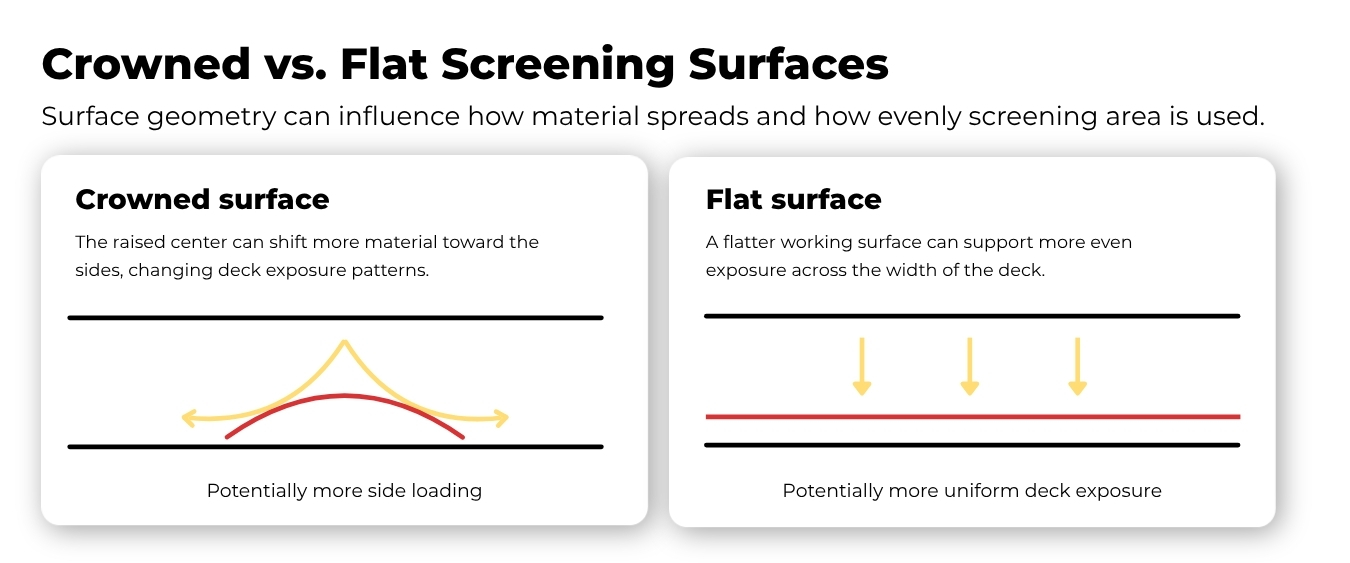
Screening surface geometry also matters because it affects how material moves across the deck.
A crowned surface can change the way the material spreads and how much time it spends in active contact with the screening area. A flat surface can create different flow behavior and different exposure across the width of the deck. These geometry effects can influence bed depth distribution, material exposure to apertures, wear concentration, and overall screening behavior.
This is why crowned versus flat should be treated as a screening behavior discussion, not just a material discussion. The geometry of the surface can change how a given media system performs, even before formulation or aperture differences are considered.
Why Theoretical Open Area and Effective Open Area Are Not the Same
Open area is one of the most commonly discussed screening metrics, but theoretical open area is not always the same as usable open area.
If part of the deck surface is occupied by hardware, affected by plugging, distorted by wear, limited by panel engineering, or exposed unevenly because of how material flows, then not all of the advertised opening is doing productive screening work. In those cases, a surface that looks better on paper may not produce the best real-world result.
Understanding this is especially important when comparing different screen surface materials, panel systems, and support arrangements. Real screening performance depends on effective open area, not just theoretical open area.
How to Choose the Right Replacement Screen Media
The best replacement screen media starts with the application, not with the worn panel you’re replacing.
A practical evaluation should consider:
- The material being processed, including size range, particle shape, abrasiveness, and moisture level
- The plant’s main challenges, such as wear, plugging, blinding, poor sizing, or lost throughput
- Impact conditions, including drop height, feed presentation, and bed depth
- The current maintenance burden and how often changeouts interrupt production
- The mounting system and support structure already in use
- Whether screening behavior is being affected by a crowned or flat surface
When recurring wear, plugging, or throughput problems continue, a Pro Analysis: Screen Performance Evaluation or Polydeck Plant Survey can help determine whether the issue is the media itself or the overall screening setup.
Like-for-like replacement can feel safe, but it often repeats the same limitations. If the current setup is wearing too quickly, losing efficiency too early, or creating unnecessary downtime, it may be time to reconsider the full media strategy rather than replacing the same design again.
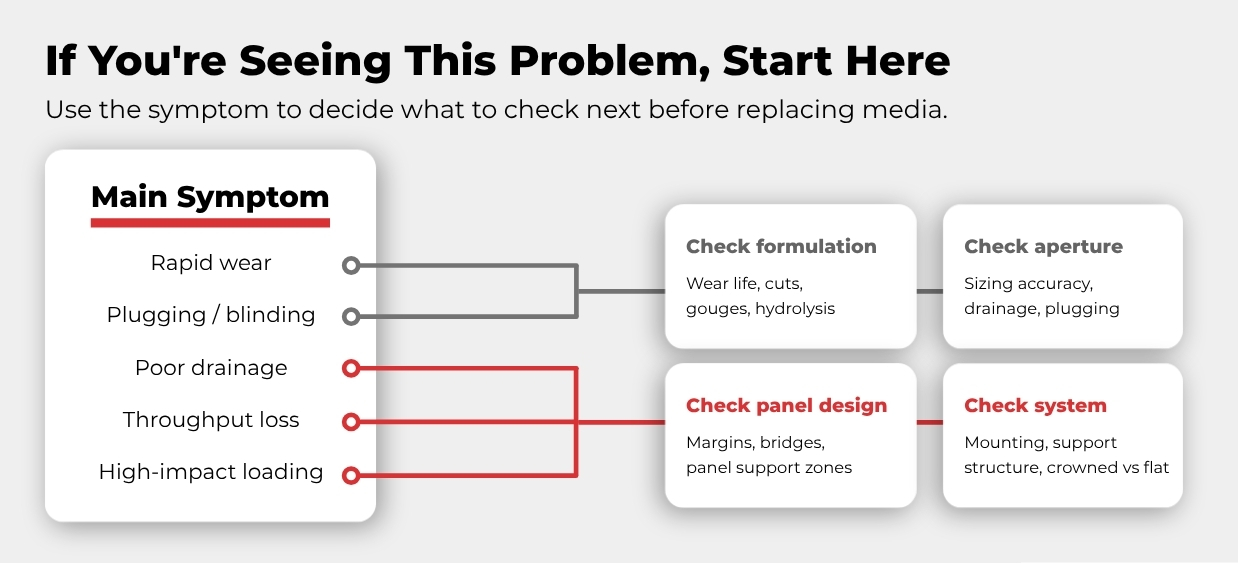
Signs Your Current Screen Media May Be the Wrong Fit
Plants should take a closer look at their media strategy when they repeatedly see:
- Frequent plugging or blinding
- Short wear life
- Loss of throughput over time
- Uneven wear across the deck
- Changing product consistency
- Carryover of undersized material
- Maintenance intervention before the media is fully worn out
- Damage concentrated around support areas or localized deck zones
When these symptoms repeat, the underlying issue may involve formulation, aperture design, mounting format, support structure, or deck geometry rather than the media material alone.
Real-World Examples of Better Media Selection
Better media selection can improve more than just panel life.
- At Toquepala, a Polydeck solution helped reduce plugging from 24% to 6.4% while improving undersize throughput by 3%.
- At Questa Mine, a revised media strategy improved screen efficiency by 50% while increasing open area from 20% to 36%.
- At Pinto Valley, a change in media strategy helped increase throughput from 48,000 to 60,000 tons per day.
These examples reinforce an important point: screen media is not simply a consumable. It’s a major part of screening performance.
How Polydeck Approaches Screen Media Selection
A strong recommendation starts with understanding how the deck is actually performing in service. That includes where wear develops, how the feed material moves across the surface, whether plugging or blinding is occurring, what the support structure looks like, and how the current maintenance pattern affects uptime.
From there, the question is not whether the next surface should be polyurethane, rubber, or wire, but which combination of material, formulation, aperture design, panel engineering, mounting system, and support strategy best fits the application.
That broader view helps plants move beyond repeated like-for-like replacement and toward a screen media strategy that better supports throughput, wear life, and maintenance goals.
 English
  Español de Chile
  Português do Brasil